· 6 min read · Julia Krebs
One Commercial Team: How Independent Hotels Align Sales, Marketing and Revenue

Picture a familiar week in an independent hotel. Revenue sees that the second half of June is pacing behind last year. Marketing, without knowing this, spends its budget promoting August, which was going to sell out anyway. Sales signs a group at a good rate, but on the one Saturday that would have sold at a much higher rate to individual guests.
Nobody did anything wrong. Each team hit its own target. The hotel still lost money.
This is what a missing commercial strategy looks like in practice. The fix is not a new organisation chart or an expensive system. It is a shared set of goals, one source of numbers and a short weekly routine where decisions are made together. The idea has been gaining ground across the industry for years: the HSMAI Foundation's report From Silos to Symphony argues for treating sales, marketing and revenue management as one "commercial" function rather than three departments.
In a small hotel, "the commercial team" may be three people, or one person wearing three hats plus the general manager. The principles are the same.
1. Agree on goals the whole team shares
As long as sales is measured on group revenue, marketing on clicks and revenue on occupancy, each team will optimise its own number. Give them a small set of goals they all own instead:
- Total revenue and gross operating profit against budget, not rooms revenue alone
- Direct share of room revenue
- Performance on the agreed need periods (the dates that need help)
- Net average daily rate after commission and acquisition costs
Individual targets can stay, but they should clearly feed these shared goals. A group that fills a need period is a win for everyone; a group that displaces higher-paying guests on a busy date is not, whatever it does for the sales target.
2. Run one weekly commercial meeting, and make it short
The single most useful habit I see in well-run hotels is a weekly commercial meeting with a fixed agenda. Not a reporting session with slides, but 45 minutes that end with decisions and names next to them.
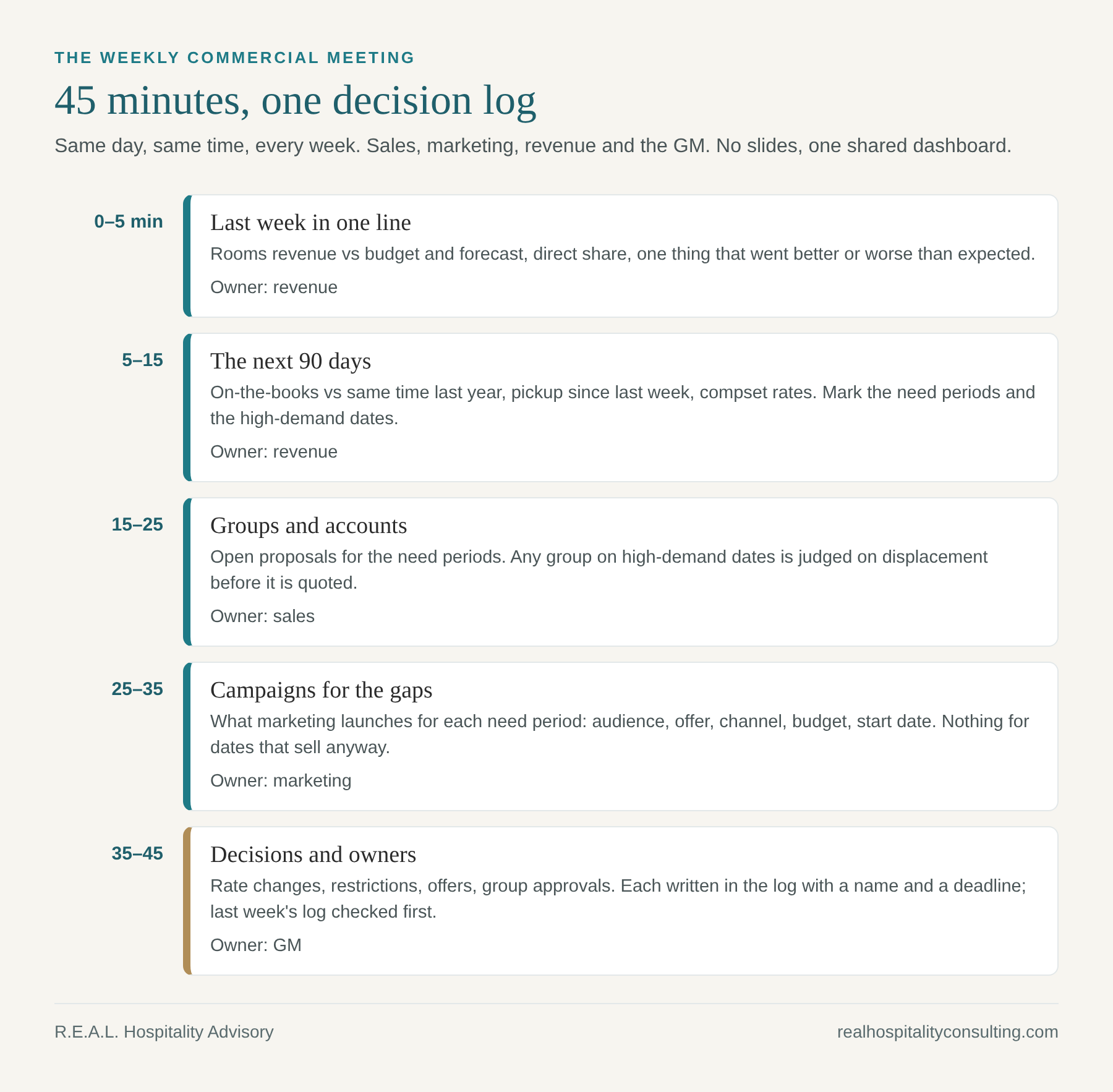
Three rules make it work:
- Same day, same time, every week. It is cancelled only when the hotel is on fire.
- One shared dashboard on the screen. Nobody brings their own version of the numbers.
- A decision log. Every decision gets an owner and a deadline, and the meeting starts by checking last week's log. This is what turns talk into action.
3. Build one dashboard, not five reports
Sales looks at the CRM, revenue at the revenue management system, marketing at Google Analytics and the GM at the monthly P&L. Each is right about its own corner and nobody sees the whole picture.
A shared dashboard does not need to be expensive. A well-built spreadsheet or a free tool such as Looker Studio is enough, as long as it is updated the same way every week. Keep it to one page:
- Occupancy, ADR and RevPAR for the next 90 days, against last year and budget
- Pickup since last week, by segment
- Compset rate position for the next 30 days
- Direct share and cost of acquisition by channel
- Group pipeline: proposals, conversion and lost business with reasons
- Food and beverage and other outlet revenue, so total revenue stays in view
4. Let demand tell marketing where to spend
Marketing gets the best return when it works on the dates that need help, not the ones that sell anyway. Turn each revenue insight into one clear marketing action:
- Midweek in June is pacing behind: targeted campaigns to the corporate and leisure markets that travel midweek, using past-guest data and a value-add such as late check-out.
- Direct share has dropped: check rate parity first, then refresh the direct booking benefits on the website and email past guests.
- The shoulder season is soft: a length-of-stay offer such as stay three nights, pay for two, aimed at the source markets that book longer stays.
- A weekend is already 95% full: no campaign at all. Let revenue raise the rate instead.
5. Point sales at the right business
Not all business is good business. Sales should spend most of its time where it helps the whole hotel:
- Groups and events for the need periods agreed in the meeting
- Corporate accounts that fill the weekdays
- Repeat accounts with a proven total spend, including meetings and food and beverage
For every group on a high-demand date, revenue and sales should check displacement together before quoting: what would those rooms earn from individual guests, and what is the group worth in total, after commission and including its food, beverage and meeting spend? Agree a minimum acceptable rate by season in advance, so sales can quote quickly without asking every time.
6. Teach each team the other teams' language
Alignment improves fastest when people understand each other's work. Short, practical sessions are enough:
- Sales learns how pricing, pickup and displacement work
- Marketing learns segmentation, booking windows and what a need period is
- Revenue learns how the sales pipeline works and why a lead can take months to close
As a lecturer, this is the part I enjoy most: once a salesperson understands why a Saturday group gets declined, the conversation stops being a fight and becomes a calculation.
7. Look beyond rooms
A commercial strategy that stops at rooms leaves money on the table. Restaurants, bars, spa, meetings and parking all belong in the same conversation. A group that spends heavily on dinner and meeting rooms may be worth more than a higher room rate, and a quiet restaurant night is a marketing opportunity like any other need period. This is where commercial strategy meets outlet profitability, and where my partner Julio's work on food and beverage comes in.
Where to start this month
- Agree three or four shared commercial goals with the GM.
- Put the weekly meeting in everyone's calendar for the next eight weeks.
- Build a one-page dashboard, however simple, and use it in every meeting.
- Start a decision log and review it at the start of each meeting.
- Mark the need periods for the next 90 days and give each one a sales and marketing action.
- Set minimum group rates by season, so sales can quote with confidence.
How we can help
We help independent hotels set up exactly this: shared goals, the dashboard, the meeting routine and the training for the teams around it. If your sales, marketing and revenue still work in separate corners, book a free discovery call and we will look at where alignment would pay off first.